 Ships USA-wide


Acoustic documents for project review. Confirm exact product and assembly applicability and review the cover letter before submitting it to your HOA.
“My HOA requires IIC 72. Which floor do I buy?” We hear it every week. Here is the honest answer: no flooring product carries an IIC 72 rating on its own, because IIC measures the entire floor-ceiling assembly — your slab, the ceiling below, and the floor working together. What a flooring system can honestly claim is how much it adds. Ours adds a lot, and we have the lab reports to prove it.
We have already published the deep guides — how to achieve an IIC 72 rating in your condo, what to do when your HOA requires IIC 72, and why an honest IIC 50–55 is already excellent. This page is the practical half: the documents.
Download the Kit (ZIP)IIC, STC, and ΔIIC in plain language
Most HOA flooring rules reference one of three numbers. They are not interchangeable, and knowing the difference is the fastest route to an approval:
IIC (Impact Insulation Class) rates how well a floor-ceiling assembly blocks impact sound — footsteps, dropped objects, chair legs. It is measured on the whole structure: slab, ceiling, insulation, and floor covering combined. A bare 6-inch concrete slab typically tests around IIC 27 on its own.
STC (Sound Transmission Class) is the same idea for airborne sound — voices, TV, music. Associations sometimes quote STC minimums alongside IIC.
ΔIIC (Delta IIC, ASTM E2179) describes impact-sound improvement under specified concrete test conditions. It differs from the complete assembly’s IIC and airborne-sound STC ratings. Compare the original reports, including the floor finish, substrate, slab, ceiling and installation conditions; do not assume a result applies to another building or a wood-joist assembly.
ΔLw (EN ISO 717-2) describes weighted impact-sound reduction in decibels under the report’s test conditions. It is distinct from IIC, STC and ΔIIC; do not substitute or add these measures. Match the specimen and complete assembly to the exact product and project.
An IIC requirement in your CC&Rs applies to the finished assembly. Match the linked reports to your exact product and construction. Review the downloadable cover letter before use; its wording does not establish project acceptance.
The numbers, on the record
The original source documents for the rows below remain linked on this page. The submission ZIP contains new templates, a checklist and a report index with links; it does not bundle original reports.
| Product / system | Tested result | Standard | Source document |
|---|---|---|---|
| 3mm cork underlayment | See linked report for the complete tested assembly; confirm exact product and project applicability. | Assembly test | Test statement (PDF) |
| 6mm cork underlayment | See linked report for the complete tested assembly; confirm exact product and project applicability. | Assembly test | Test statement (PDF) |
| 12mm cork underlayment | See linked report for the complete tested assembly; confirm exact product and project applicability. | Assembly test | Test statement (PDF) |
| 12mm cork floating flooring (e.g. Silver Birch) | Ask us which report applies to this 12mm product and your complete assembly, including the specimen thickness. IIC and ΔLw are distinct metrics. | ISO 140-8 | Test report (PDF) |
| 11mm Swiss Design cork floating (e.g. Sandstorm) | 18 dB impact sound reduction (ΔLw) | EN ISO 717-2 | Test report (PDF) |
| 10mm cork floating lines (Terrazzo, Sustainazzo, Shoreline, Venetian) | A result from an 11mm specimen does not establish 10mm product applicability. Confirm the exact SKU and assembly against the original report. | EN ISO 717-2 | Test report (PDF) |
| Grano 10mm cork floating | 18 dB impact sound reduction (ΔLw) | EN ISO 717-2 | Figure per product listing |
| Swiss TechSlate 7.5mm (e.g. Bright Stone) | Approx. 19 dB impact sound improvement | EN ISO 717-2 | Figure per product listing |
| 6mm glue-down cork tile | 18 dB impact sound reduction | — | Figure per product listing |
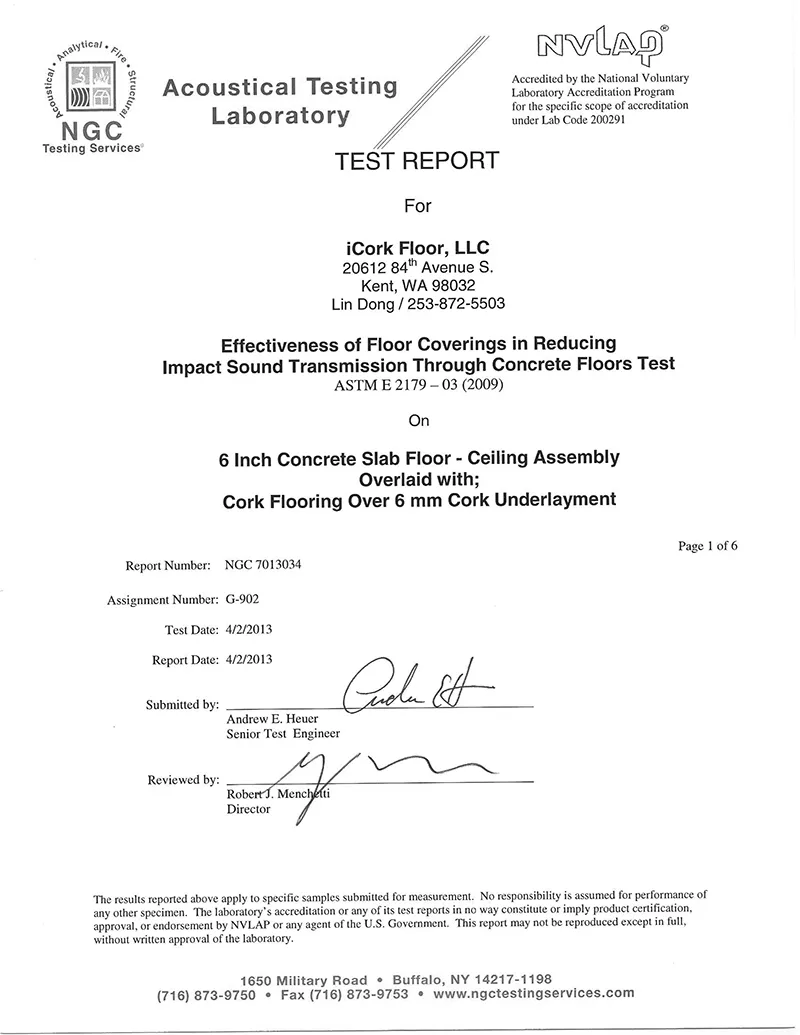
| 11mm cork floating floor + 6mm cork underlayment | See linked report for the complete tested assembly; confirm exact product and project applicability. | ASTM E2179 (NGC report 7013034) | Test summary (JPG) |
Tested combinations: 12mm cork floating floor over cork underlayment
| Combination | Total tested sound reduction | Source document |
|---|---|---|
| 12mm floating floor + 3mm cork underlayment | 31 dB | Test sheet (JPG) |
| 12mm floating floor + 6mm cork underlayment | 42 dB | Test sheet (JPG) |
| 12mm floating floor + 12mm cork underlayment | 67 dB | Test sheet (JPG) |
The 60-second version for your HOA board
- IIC and STC describe the complete tested assembly. Compare reports with the same relevant floor, slab or substrate, ceiling and installation conditions; a product label alone does not establish your building’s result.
- ΔIIC (ASTM E2179) measures impact-sound improvement under specified concrete test conditions. Review the original report for the exact specimen and installation; do not treat it as building-independent or transfer it to wood-frame construction.
- Every statement in this kit is a document your board can file: test reports per product thickness, on a standard 6-inch concrete reference slab, with and without a suspended ceiling.
Recommended HOA-friendly combinations
Best acoustic result — the board-pleaser. 12mm cork floating flooring over 12mm cork underlayment. Tested at 67 dB total sound reduction; the underlayment alone carries IIC 75 / STC 76 on 6-inch concrete. For wood-frame buildings and the strictest associations.
Best value — the tested assembly. Any 11–12mm cork floating floor over 6mm cork underlayment. This is the exact combination tested to ΔIIC +20 (ASTM E2179) — the number to lead with in the cover letter, because it is building-independent. The 12mm floating version of this pairing tests at 42 dB total reduction.
Slim profile / over radiant heat. Swiss Design 11mm cork floating — 18 dB (EN ISO 717-2), no separate underlayment required thanks to its attached cork underlay layer. Where ceiling height or hydronic heat rules out thick assemblies.
Glue-down route (where the HOA requires bonded floors). 6mm glue-down cork tile at 18 dB impact sound reduction.
Design-led. Swiss TechSlate 7.5mm offers stone visuals. Review the original acoustic report for exact product and assembly applicability and confirm the project’s approval requirements.
Download the kit
Submission ZIP: printable and editable cover letter, submission checklist and report index linking to originals. Original documents remain available on this page.
- Printable cover-letter template (PDF); complete it for your exact products and assembly
- Editable cover-letter template (Markdown); fill and save offline
- Submission checklist for building requirements, installation and applicable evidence
- Original report index with source links; confirm current-product and assembly applicability
- Technical, warranty and certification source links; attach only documents applicable to your project
Before you submit
Ask your HOA or property manager for the required complete-assembly rating and the project’s construction details. Adding an existing IIC rating to a ΔIIC result does not establish the finished assembly’s IIC or project acceptance. Review the applicable report and submission requirements before using the cover-letter template.
Common HOA questions
My HOA requires IIC 72. Which of your floors meets that?
None on its own — and no competitor’s floor does either, because IIC 72 is an assembly rating, not a product rating. The path to 72 is the building’s existing rating plus your flooring system’s tested contribution. Our 11mm floating floor over 6mm cork underlayment is lab-tested at ΔIIC +20 (ASTM E2179), and the kit gives your board the documents to verify it. Read the full walkthrough in our IIC 72 guide.
My building is wood-frame, not concrete. Does the kit still help?
Yes — wood-joist buildings transmit far more impact sound than concrete slabs, so they benefit the most from a real acoustic layer. Lead with the ΔIIC +20 assembly result (it is building-independent) plus the per-product test statements, and choose one of the thicker combinations above. More detail in why condo floors still have noise complaints.
Will my HOA actually accept these documents?
The linked acoustic documents are starting points for project review. Check the original reports for the metric, specimen and complete assembly, and confirm exact SKU applicability. Review the downloadable cover letter before use; it does not establish technical compliance or approval.
Can I keep my laminate or LVP and just use your underlayment?
In most cases, yes. Cork underlayment works under almost any floating floor, and many owners use it exactly that way to satisfy an HOA. Pairing it with a cork floating floor adds a second acoustic layer and the highest tested results — see noise reduction and sound control for the per-thickness figures.
 Flooring
 Wall & Ceiling Tiles
 Cork Underlayment
 Supplies & Guides


