 Ships USA-wide

Best Waterproof & High-Humidity Flooring for Coastal, Tropical and Damp Homes
Looking for waterproof flooring for high humidity doesn’t mean you have to settle for vinyl or other plastic-based flooring.
Living near the ocean, in a tropical climate, in a heavily wooded area, over a crawl space, or even on a houseboat can create a flooring challenge that homeowners in dry climates rarely have to think about.
You may love the warmth and comfort of cork or other natural flooring, but you also need a floor that can tolerate humidity and moisture.
Many homeowners assume their only practical option is vinyl or another plastic-based waterproof floor.
It isn’t.
For homeowners looking for waterproof or high-humidity flooring without giving up comfort, natural materials, indoor air quality and long-term durability, there are several alternatives worth considering.
At iCork Floor, three flooring systems are particularly useful for moisture-sensitive projects:
-
Glue-Down Cork Flooring
-
Swiss TechSlate® Mineral Flooring
-
Forna Natural Composite Flooring with Waterproof Hydrowood Core
The right choice depends not only on how humid your climate is, but also on where the moisture is coming from and what type of subfloor you have.
That distinction is extremely important.
First: Humidity and Subfloor Moisture Are Not the Same Thing
Before choosing any flooring for a humid environment, separate three different moisture conditions:
1. High indoor relative humidity
This is moisture in the air.
It is common in places such as:
-
Hawaii and other tropical climates
-
Florida and Gulf Coast communities
-
coastal homes
-
East Tennessee and the Southeast
-
heavily wooded areas
-
lake houses
-
homes near wetlands
-
homes with crawl spaces
-
houseboats and other marine environments
Air conditioning and dehumidification can substantially change the conditions inside the house even when outdoor humidity is extremely high.
2. Moisture coming through the subfloor
This is different.
A concrete slab can transmit moisture from the ground below it. Crawl spaces can also introduce moisture beneath a floor assembly.
A flooring material being waterproof does not automatically mean that every adhesive, subfloor or installation system underneath it is waterproof.
3. Direct water exposure
Bathrooms, laundry rooms, kitchens, spas, commercial spaces and flood-prone basements may occasionally experience actual standing water.
These conditions require another level of moisture protection.
Understanding which of these three conditions applies to your project is the first step toward choosing the correct floor.
What About Traditional Floating Cork Flooring?
Traditional cork floating flooring remains an excellent choice in a climate-controlled home.
Cork is naturally warm, quiet, resilient and comfortable underfoot. It is particularly attractive to homeowners who want something very different from cold tile or synthetic vinyl flooring.
However, many floating cork floors contain an engineered HDF core.
The cork itself handles humidity extremely well, but the HDF core is not the same thing as solid cork or a waterproof mineral core.
In a home with central air conditioning or dehumidification where indoor relative humidity can be maintained within the flooring manufacturer’s recommended range, floating cork can still be an excellent choice—even when the outdoor climate is humid.
The important number is therefore not simply the outdoor humidity reported by your weather app.
What matters is the environment inside the house.
If indoor humidity cannot be reliably controlled, or if the project has a higher probability of water exposure, we recommend looking more closely at one of the following three systems.
Option 1: Solid Glue-Down Cork — The Most Natural Cork Solution
For homeowners who want the actual feel and performance of cork without an HDF core, 6mm or 8mm solid glue-down cork tile is one of our favorite solutions.
These tiles are cork through their full thickness.
There is:
-
no HDF core
-
no plastic waterproof core
-
no vinyl wear layer
The floor has a resilient cork surface. Compare its feel with a sample and review its acoustic test data.
Cork’s cellular structure gives the floor its characteristic softness and thermal insulation. It also absorbs impact sound and is far more comfortable to stand and walk on than stone or ceramic tile.
6mm vs. 8mm Cork
Both thicknesses provide the advantages of solid cork.
The 8mm tile provides additional cork mass, making it particularly attractive when greater thermal and acoustic insulation is desired.
For homeowners living in humid coastal or tropical areas who specifically want genuine cork, glue-down cork can therefore be an excellent solution—provided the subfloor is appropriate.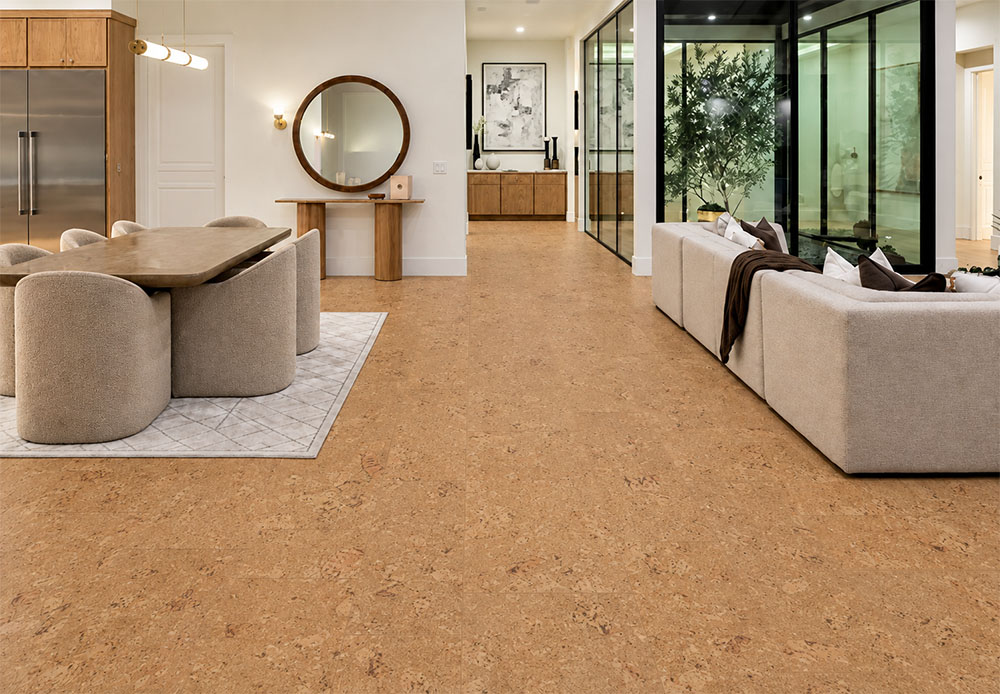
That last condition is critical.
The Subfloor Matters More Than the Climate
A successful glue-down cork installation begins with the substrate.
The surface must be:
-
structurally sound
-
smooth
-
flat
-
clean
-
dry
-
free of contaminants
-
compatible with the specified adhesive
Floor imperfections can telegraph through a glue-down cork tile, so proper preparation is essential.
Flooring-grade plywood is generally one of the most straightforward substrates for a glue-down cork installation.
Concrete requires considerably more attention.
Important: Glue-Down Cork Over Concrete
We do not recommend installing glue-down cork directly over below-grade concrete such as a typical basement slab.
This is true even though cork itself tolerates water extremely well.
Why?
Because the floor is a system.
The cork may tolerate moisture, while moisture or alkaline salts migrating through concrete can interfere with a water-based contact adhesive.
For this reason, concrete used for a glue-down cork installation should be at or above grade, properly prepared and moisture tested before installation.
Never assume that concrete is dry simply because it looks dry.
A slab can appear perfectly dry at the surface while continuously transmitting moisture from below.
For below-grade basements, flood-prone areas or slabs with uncertain moisture conditions, a different flooring system—particularly TechSlate—may be a much safer choice.
Finishing a Glue-Down Cork Floor
The installation does not end when the cork tiles are bonded.
Our factory-finished glue-down cork flooring requires the specified site-applied coats of LOBA 2K Supra A.T. water-based polyurethane after installation.
The site finish protects the completed surface and, importantly, seals the joints between individual tiles.
This is one of the reasons glue-down cork can work so well in kitchens, entrances and other locations where occasional spills are expected.
The finished installation becomes a continuous cork surface rather than a collection of exposed tile seams.
Special Substrates: What About Fiberglass?
We occasionally receive questions from customers installing cork in unusual environments, including boats and houseboats with fiberglass floors.
This requires special attention.
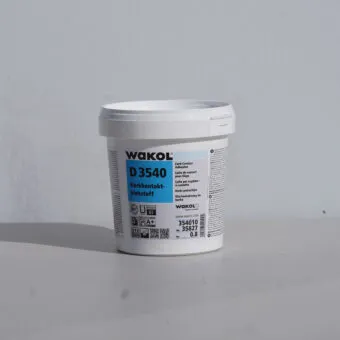
Standard WAKOL D 3540 Cork Flooring Adhesive is a water-based contact adhesive approved for natural cork tiles over porous and non-porous substrates. However, fiberglass is not specifically identified in the standard WAKOL D 3540 technical data sheet.
For unusual substrates, never assume compatibility simply because the surface is described as “non-porous.”
One interesting alternative is 3M™ PB2008 Water Based Contact Adhesive.
According to 3M’s published product information, PB2008 is a high-strength, high-temperature-resistant water-based contact adhesive suitable for a variety of substrates, and 3M specifically lists both cork and fiberglass among those materials.
That does not mean that every fiberglass boat floor is automatically approved for a cork installation.
Fiberglass surfaces can contain coatings, waxes, release agents, finishes and other contaminants that dramatically affect adhesion.
For any unusual substrate such as fiberglass:
-
identify the exact substrate and surface coating
-
consult the adhesive manufacturer’s current technical instructions
-
determine the required sanding or surface preparation
-
thoroughly clean and prepare the substrate
-
perform a small bond/adhesion test before proceeding
-
obtain manufacturer or professional technical approval when appropriate
Marine environments introduce additional variables including condensation, temperature changes, movement and prolonged humidity.
The flooring, adhesive and substrate therefore need to be considered as one complete system.
Option 2: TechSlate® — Our Strongest Solution for Severe Moisture Conditions
For basements, high-humidity homes and demanding commercial environments, TechSlate deserves special consideration.
TechSlate is manufactured in Switzerland using a predominantly mineral, fiber-cement construction rather than a conventional wood-based flooring core.
This creates an unusual combination: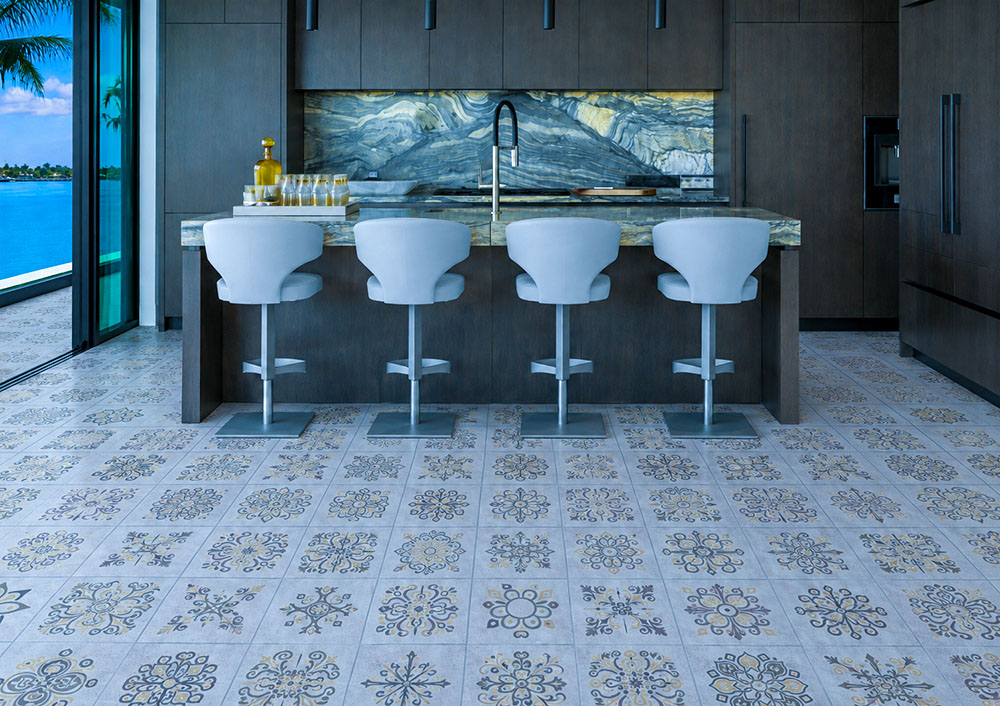
the dimensional stability and water resistance of a mineral floor with the convenience of a modern click-lock flooring system.
0% Thickness Swelling After 24 Hours
According to the manufacturer’s EN 317 technical testing, TechSlate’s mineral core records:
0% thickness swelling after 24 hours.
That is a fundamentally different moisture response from conventional wood-fiber flooring.
For homeowners concerned about basement moisture, tropical humidity or accidental water exposure, this is one of TechSlate’s most important advantages.
Commercial Class 33 / Residential Class 23
TechSlate is not simply a residential waterproof floor.
It carries a Commercial Class 33 rating under EN 16511 and an AC5 abrasion rating, making it appropriate for demanding environments.
Applications can include:
-
homes
-
basements
-
kitchens
-
restaurants and cafés
-
hotels
-
retail stores
-
offices
-
healthcare environments
-
schools
-
galleries
-
other high-traffic commercial spaces
Its mineral construction also provides excellent dimensional stability.
Easy Click-Lock Installation
Despite its mineral construction, TechSlate does not install like conventional ceramic tile.
It uses a precision click-lock system and can normally be installed as a floating floor over a properly prepared substrate.
This can dramatically simplify renovation compared with traditional stone or ceramic flooring.
For continuously wet, flood-risk or specialized commercial applications, a bonded installation may also be considered according to the applicable installation specification.
Waterproof Without Turning to Vinyl
This is one of the main reasons we recommend TechSlate to environmentally conscious homeowners.
Many consumers searching for “waterproof flooring” are immediately directed toward vinyl.
TechSlate provides another path.
Its construction is predominantly mineral rather than plastic-based, and it is designed for long service life and eventual recycling through the manufacturer’s Second Life program.
It also provides approximately 19 dB of impact-sound reduction—an unusual advantage for a mineral-based floor.
For a basement or another difficult moisture environment where glue-down cork is not appropriate, TechSlate may be the first product we would investigate.
Option 3: Natural Composite Flooring — Waterproof Performance With a Warmer Feel
Some homeowners want waterproof performance but do not want the stone or concrete character of a mineral floor.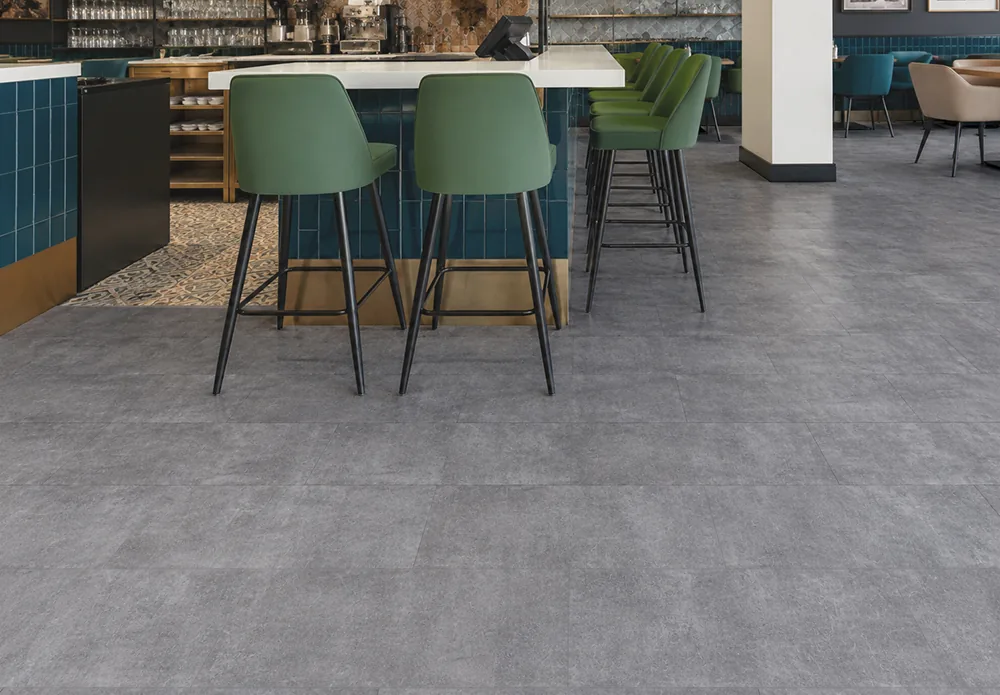
That is where Forna Natural Composite Flooring becomes particularly interesting.
This Swiss-made floating floor combines three layers:
**Natural composite surface
-
waterproof Hydrowood core
-
cork backing**
The result is a floor that provides much of the warmth and acoustic comfort people associate with cork while offering significantly greater moisture protection than a conventional HDF-core floating floor.
Waterproof Hydrowood Core
The 6.8mm Hydrowood core has a 24-hour thickness swelling value of less than 1% under EN 317 testing.
This makes Natural Composite an excellent candidate for kitchens, humid climates and other spaces where homeowners want additional moisture security.
A Surface Based on Natural Ingredients
The surface is made primarily from renewable and mineral ingredients including:
-
linseed oil
-
pine resin
-
limestone
-
cork wood flour
-
jute
The floor therefore offers a very different material story from conventional vinyl flooring.
Cork Backing for Comfort and Sound
Underneath the waterproof core is an agglomerated cork backing.
That layer contributes to the floor’s warmer feel and acoustic performance, with approximately 18 dB impact-sound reduction depending on the product specification.
This makes Natural Composite particularly attractive for:
-
bedrooms
-
living rooms
-
kitchens
-
upper floors
-
apartments
-
coastal homes
-
humid climates
where the owner wants waterproof-core performance without giving up comfort.
Built for Heavy Use
Natural Composite is rated:
Class 23 for residential use
Class 33 for commercial use
and uses a click-lock floating installation system.
Selected Natural Composite products also carry UL GREENGUARD Gold certification for low chemical emissions, an important consideration for homeowners concerned about indoor air quality.
Explore Forna Natural Composite Flooring
How to Choose Waterproof Flooring for High Humidity?
Here is a simple way to begin the decision:
| Your Situation | Flooring to Consider |
|---|---|
| Climate-controlled coastal or humid home | Floating cork may still be suitable |
| Want genuine natural cork without an HDF core | 6mm or 8mm glue-down cork |
| Plywood subfloor in a humid environment | Glue-down cork is worth considering |
| At/above-grade concrete that passes moisture requirements | Glue-down cork may be appropriate |
| Below-grade basement concrete | TechSlate is generally the better starting point |
| Flood-risk or severe moisture concerns | TechSlate |
| Want a waterproof floating floor with wood/concrete designs | Natural Composite |
| Want a predominantly mineral, extremely dimensionally stable floor | TechSlate |
| Want warmth, softness and maximum cork content | Glue-down cork |
| Want natural-material character plus easy click installation | Natural Composite |
| Fiberglass or another unusual substrate | Obtain adhesive compatibility confirmation and perform a bond test |
This table is a starting point—not a substitute for evaluating the actual building.
Don’t Choose Flooring Based on Outdoor Humidity Alone
This is particularly important for homeowners in Tennessee, Florida, Hawaii, the Carolinas, coastal areas and other humid regions.
A house can be located in an extremely humid climate while maintaining perfectly reasonable indoor conditions through air conditioning and dehumidification.
Conversely, a house in a relatively dry climate can have serious flooring moisture problems because of an improperly managed crawl space or wet concrete slab.
When planning your floor, ask:
What is the indoor relative humidity?
Is the home air-conditioned or dehumidified?
Is the floor over a crawl space, plywood, concrete or another substrate?
Is the concrete above grade or below grade?
Has the slab been moisture tested?
Is occasional water exposure possible?
Could standing water or flooding occur?
Those answers are more useful than your ZIP code alone.
A Waterproof Floor Still Needs a Dry, Properly Prepared Subfloor
This point cannot be overstated.
“Waterproof flooring” describes the flooring material’s response to water. It does not mean that moisture underneath the flooring can simply be ignored.
Even a waterproof floor needs an installation system appropriate for the building.
Excess moisture trapped underneath a floor can affect:
-
adhesives
-
primers
-
leveling compounds
-
concrete
-
plywood
-
indoor air quality
-
the building itself
Always investigate the source of moisture rather than relying on the finished flooring to hide it.
Natural Flooring for a Wetter World
Waterproof flooring no longer has to mean plastic flooring.
For homeowners trying to combine moisture performance with comfort, indoor air quality and more natural materials, today’s flooring technology provides several very different solutions.
Solid glue-down cork provides the warmth, quietness and resilience of genuine cork without an HDF core.
TechSlate has a waterproof mineral core and a listed commercial traffic rating. Follow the product’s room-specific installation and moisture requirements.
Natural Composite Flooring combines a natural linseed-based surface, waterproof Hydrowood core and cork backing in an easy-to-install floating floor.
There is no single flooring system that is best for every humid home.
The correct choice depends on the relationship between climate, indoor humidity, water exposure, subfloor construction and installation method.
That is why we encourage customers in unusual environments—coastal homes, tropical climates, crawl-space homes, basements, houseboats and other high-humidity locations—to discuss the complete project rather than choosing flooring based only on appearance.
Start With Samples
Color and texture can look very different in natural light than they do on a computer screen.
Order samples of the floors you are considering, evaluate them in the actual room, and then confirm your subfloor and moisture conditions before placing the full flooring order.
A little planning before installation can make the difference between simply finding a floor that survives humidity and choosing a floor that remains beautiful, comfortable and durable for years.
When choosing waterproof flooring for high humidity, always consider the subfloor, indoor relative humidity and potential water exposure together.
 Flooring
 Wall & Ceiling Tiles
 Cork Underlayment
 Supplies & Guides