 Ships USA-wide

Insulation flooring answer
Flooring R-values and cork insulation
Flooring R-values help compare thermal resistance, but a warmer room also depends on the subfloor, finished flooring, underlayment thickness, and air sealing. Cork underlayment can support thermal comfort while also helping with sound control.
- Compare cork underlayment thicknesses such as 3mm, 6mm, and 12mm before choosing a full project layer.
- Use cork when the project needs thermal comfort, acoustic support, and a renewable material under or as the finished floor.
- Order samples so finished height, density, color, and underfoot feel are clear before full boxes.
Floor Insulation R-Values and Cork Underlayment
The more multifamily unit houses that are built, the more important acoustic testing,insulation ratings, Sound Ratings becomes. It is also one of the most controversial and confusing topics a homeowner, strata council, architect or designer will ever encounter. This write-up helps to break down well-known brand available to the average homeowner and what the company has done to achieve such high ratings. STC 72 and IIC 73 are common numbers but how does this company make a 3.2mm piece of air filled plastic offer up such amazing sound properties?
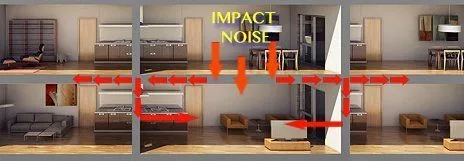
The answer is simple: they don’t because they can’t. The company spent a tremendous amount of money and materials (someone else’s materials in this case) to increase the value of the product on the shelf. The bottom line is – that which is most important to homeowners and condo boards – most buildings (80%-90%) do not and cannot incorporate the type of materials needed to reproduce such astounding numbers. This leaves the tenants in the building upset that they have “…done everything we were told to,” yet their neighbors still complain about the noise!
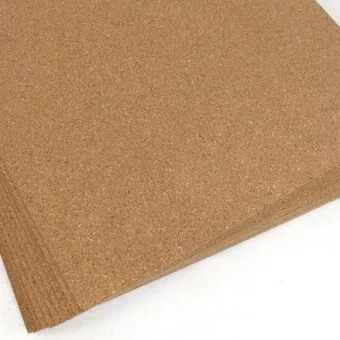
Forna 6mm Cork Underlayment
Test Results available upon request: Contact iCork Floor LLC
Forna Cork Underlayment
Test Results available upon request: Contact iCork Floor LLC
We’ve our ½”. ¼” and 1/8” cork underlayment offers a reduction of 48 dB, 23dB, 12dB, and 10mm and ½” floating cork flooring each offer a reduction of 19dB (the 10mm line tested at 11mm). Our ½” cork floating floor/½”. ¼” and 1/8” underlay combination offer a reduction of 67 dB, 42 dB and 31 dB.
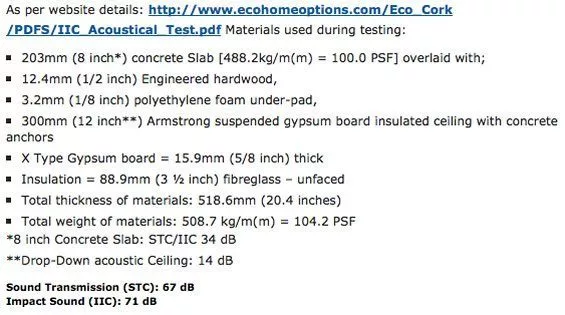
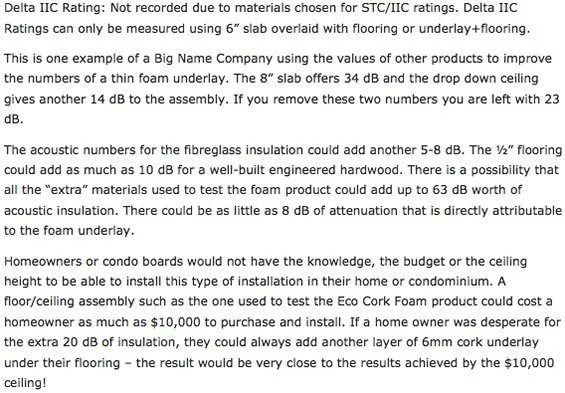
You can download supporting documents here and provide to your HOA.
1/2″ (12mm) cork underlayment IIC STC statement.
1/4″ (6mm) cork underlayment IIC STC statement.
1/8″ (3mm) cork underlayment IIC STC statement.
1/2″ (12mm) cork floating IIC report.
Cork thickness and insulation
Compare thermal data for your floor assembly, then check thickness, floor compatibility and installation requirements.
Compare cork thickness and insulation
Compare cork thickness and the thermal and acoustic data for your complete floor assembly.
Frequently asked questions
Is cork good for floor insulation?
Yes. Cork underlayment and cork flooring can help with floor insulation, thermal comfort, and sound control when the thickness, installation method, subfloor, and finished floor are matched to the room.
What cork underlayment thickness should I compare for R-value?
Compare 3mm, 6mm, and 12mm cork underlayment by finished floor height, acoustic needs, thermal comfort goals, and whether the floor manufacturer allows an underlay layer.
Does cork flooring feel warmer than tile, vinyl, or hardwood?
Cork often feels warmer and more resilient underfoot than many hard surfaces because of its cellular structure, but comfort depends on the room, subfloor, finish, and installation.
Should I order samples before choosing insulation flooring materials?
iCorkfloor recommends samples so buyers can compare cork thickness, feel, density, finished height, color, and room lighting before ordering full underlayment or flooring boxes.
 Flooring
 Wall & Ceiling Tiles
 Cork Underlayment
 Supplies & Guides